Version 2 - The Pilot
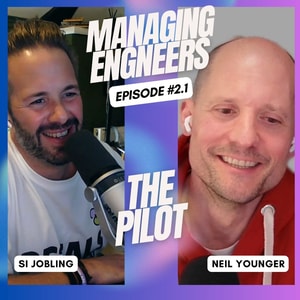
Two engineering managers kick things off with stories from their past, lessons learned the hard way, and why they’re starting a podcast about the human side of tech leadership.
Transcript
Foreign.
Speaker B:This is the second version of the Managing engineering podcast where Si and Neil learn about each other through a shared passion for managing software engineers. Are we comfortable?
Speaker A:I am, yeah. I'm standing today. I thought I would. I've been doing a lot of sitting. Not that I often sit when working. I often stand, but I was trying to get this feels more comfortable. So all good.
Speaker B:I think it's better for your vocals when you are standing. I'm just being lazy today and sitting because I can't bother to sit up. Standing desk now can be a bit.
Speaker A:Faffy sometimes and especially as it changes the height of everything and then you, you're moving things around. But that's all good. I'm. I'm all good. How are you, Si?
Speaker B:I'm doing good. It is Friday afternoon and the end is in sight. Got a few more hours. This is part of it, which is all good fun. How about you?
Speaker A:Yeah, So I work nine days and 10, so it means I do extra hours. Still do all the hours during the make it off and it means every other Friday I have off and this is one of those every other Friday. So no work for me today, which is great to fit this type of stuff in. So it means I. No one's going to be gate crashing the day with the meeting and I can just sit back and enjoy it.
Speaker B:Cool. Yeah, I don't have that luxury, unfortunately. I'm definitely jealous of your nine day fortnight.
Speaker A:It. It works well. Sometimes though, it can be a little bit more difficult because if things happen at home or you just want to finish on time, you feel like, oh, hang on a minute. No, I need to do another hour today.
Speaker B:Right.
Speaker A:When's that gonna happen? And you're fitting in, but it's pretty flexible. So sometimes I don't like some, some weeks I, I won't if I haven't done the hours and I'll just do a couple extra on Friday. But it is nice to have the option and yeah, it's nice to get some other stuff done as well, which is always good.
Speaker B:Lovely. So I think we've jumped ahead a little bit now. So if we rewind just a little bit to sort of talk about who we actually are. We know each other kind of, but I think it'd be nice for any listeners to kind of understand what we do, who we are, names, all that sort of jazz, whatever you want to share. Do you want to go first, Neil?
Speaker A:Of course, yeah. Well, I think we, the listeners hopefully would have guessed that I'm called Neil. I AM have been around software and software engineering I think for quite some time now. We weren't exposed for to for how long but we can imagine it's a long period of time. Graduated and was wondering what I was going to do with my sort of technology focused degree. Went into a company not really fully understanding what software engineering was. So joined as many people did at that time within this sort of testing function. Really enjoyed it, really engaged with what I wanted to do and stayed in that for many, many years sort of I think that allowed me to really start seeing I think quality beyond just software engineering, especially from a business point of view. Found myself in various leadership roles which I really enjoyed. Started line managing which sometimes isn't a choice, it just sometimes comes with a responsibility as you progress. But I found I really loved that side of helping and supporting people too. So that's continued. I'm now working in sort of software engineering and again in similar leadership roles. Yeah I'm sure we can go into a lot more history throughout this whole series but just a little bit of an oversight. How about yourself?
Speaker B:SI Very nice and very similar. So yeah, university classically trained let's say with software engineering as a sort of discipline. My course was called Interactive Multimedia though it's quite cutting edge at the time. Not trying to brag but because it was at a period in time when the Internet was just becoming a thing and people are going oh what do we do with this? And CD ROMs and media in that sense was a thing too. Digital music was the thing. So I like the broadness of that course and what it allowed me to do was zoom in on a tech that I really enjoyed and that was the web I'm just going to be putting out there. So this was sort of end of 90s early noughties graduated, kind of went cool. I'd managed to get a placement during that which was a web development job as well. Continued that briefly but then jumped into local services or to the fire service for about four years doing the same sort of stuff, software engineering. Jumped around a few organizations including Yahoo. I went to Alibaba for a bit insurance that won't go into that too much and then ASOS was my where I cut my teeth into management. So I was sort of being more of a senior tech leader role at that point but my line manager at the time even realized went SI are you quite cutting it to be our tech lead anymore? Because I don't think you quite understand what we're trying to do. I get it. I just don't do it very well, I'm going to be honest. So I know how to get other people around me to do this. And he's like, I think you're good with people. You're good with the stakeholder people side of things. So how about you try that angle? And that was my angle into leading and management as a role. That's probably about 10 years ago, really. So fast forward now. I've been like leading engineers, software engineers, instead of doing the actual code.
Speaker A:We will definitely have to dig into a little bit of the history, I think, because I didn't realize. I mean, we have met and we've met in person, but I wouldn't say we know each other that well. It's going to be interesting to explore a little bit of that, I think, certainly through the, through the series. And yeah, I'm certainly would be curious in terms of that shift and what you made, what made you. Or, you know, it sounds like you had a good, supportive manager who could have sent you in a different direction and could have challenged you in a different way. So, yeah, I think there's some good, good things that we can explore.
Speaker B:Oh, absolutely. And that, that's why I like this, the idea of this podcast, because when we touch base a few weeks back, well, actually about a month ago now, just before the summer break, but like, we've got a lot of different angles and topics we love to dive into. We just don't have the time for it. So let's make the time, create a podcast. And I'm pretty sure others in our industry will like to know how we got into it and maybe learn a few things or even challenge it, because that's where I want to get from this is we just experiment and share with what we've been doing and what we've done well, and not.
Speaker A:I'm, I'm very mindful that the things that I've done, I can't go back and fix them, but I can go back, I can look back and learn from them effectively. And I'm very confident that I don't do many things right. And I think the opportunity to learn is always an important one. And that's, I think that stayed true and will continue to stay through throughout this whole career. And I think that's why I love it so much, is I look back and think, what did I need to know five years ago, 10 years ago, 15 years ago? And it's just, it's similar, but so, so different.
Speaker B:And I think having that growth mindset is probably one of the hardest skills and abilities to have in any industry, but it's much more needed in engineering and tech because none of us get it right first time. I even got it tattooed over the summers, like perfection's not a thing, you know? So I'm like, I firmly believe we will make mistakes. It's just creating a safe space to do it without causing an absolute mess the people around you.
Speaker A:I feel like creating an absolute mess for the people around you could be an interesting topic for a future one. I certainly have some stories when I was a young, naive engineer.
Speaker B:Absolutely. What was the. What was the biggest mistake you ever made, though you reckon in tech that.
Speaker A:You could talk about, and I can talk about it now, and I. I feel like time has gone and people have healed. So it was, it was at a time I was working with and for a big bank, a big multinational bank. It was at a time, I think, where people felt very comfortable and certainly my seniors felt very comfortable fixing things on live in backend Oracle database. That seemed to be okay. And, and now when I say that out loud, it sounds horrific. And I remember dropping the entire banking database because I thought I was on prepod or something else, and I just dropped it completely and then spent a very panicky next entire afternoon with a couple of the senior DBAs just trying to get everything back up. Yeah, that was. Wow. That was a very interesting life lesson as a young engineer. I mean, I should never have been allowed to do that and I should certainly have had challenged myself in terms of is this okay? But, yeah, I think, I think I'm glad I learned that early in my career when it was sort of safe.
Speaker B:The best mistakes, when you're new to tech, right. And you kind of go, jesus, don't do that again. And it just, it sets you up to succeed better in the future, I find.
Speaker A:Yeah. How about yourself? Is there anything that sort of comes out, like if I was asking you an interview question, in terms of what have you know, what have you learned, what may have been a mistake and what might come out?
Speaker B:I think the, the biggest mess up I made from an engineer perspective was similar. I used to work for a pretty large retailer online and I had access to tools that were pretty much on every web page of that script of that site. We did a lot of like, MVT testing, We did a B testing, a lot of kind of tracking, like with pixels and stuff like that. But there was one specific script that was pretty much embedded on every single page. And someone said, si, can you just make that change for us. I was like, sure. Where, though? Because I can't just deploy like that. He went, just use that, you know, use that tool that authenticates all the pixels. Put it out there. And I didn't realize for about 15 minutes I'd taken the whole site down. I was like, oh, whoops. Someone said, are you able to open the website in a moment? And I was like, no. Yes, but no. And I looked and went, hold on. Take it out. Yeah, it was me. Whoops. Thankfully, I could save it, deploy it really quick. But I was like, oh, my God. For 15 minutes the site was down because I made a stupid change.
Speaker A:And it's sometimes so easily done and seem so, so trivial, I say, I'm just changing that, that zero to a one. It'll be fine.
Speaker B:Yeah, I think it was like a missing semicolon or a missing apostrophe, which is like you say, easily done without the right tools in place. And I was like, right, again, let's learn from this. What can we do to limit that happening in the future? What tests are we putting in place before we make these changes? Because it wasn't. It was literally copy and paste into a text area that was cascaded across all sites.
Speaker A:Wow.
Speaker B:Let's not do that again.
Speaker A:We have the opportunity even now, right, to do that with certain content tools that allows us to manipulate sites online, run experiments that sort of allow and give, like, and very needed access to people. But it also gives that a level of things that you can break.
Speaker B:Absolutely. And to be fair, in that situation, I was on the MVC team. We didn't have any QAs, like, or testers in the team. And I was like, we definitely need some testers to help us because us developers are not the best when it comes to checking everything.
Speaker A:We will feel like that could be. Could be. And it could be one maybe, because I can. I can put my old tester hat on and we can have a conversation about some of that as well. I think that that could be a fun one.
Speaker B:That'd be fun. Let's go back to your journey, your career and getting into tech. What motivated you to even think about work, working in this world?
Speaker A:Oh, that's a great question. Part of it was just, I think I've always. I've always had some form of tech around from, like, Commodore 64. I was one of the fancy kids that had the cartridge rather than the tape deck at one point.
Speaker B:Yes.
Speaker A:Typing that all in both.
Speaker B:But yeah, I know what you mean.
Speaker A:So I think it was My parents weren't well off, but they, I think they had realized that computers were going to be a thing and wanted to, to make sure that, you know, there was the computer in the, in my parents bedroom. That was the location that we went for to type in the program. So I think it was always there and it felt like a natural choice when going to university. But I also did psychology because I really loved the social sciences, I think. And looking back that is probably now I can see where my, my sort of love of working with people has come from, from that side of things. But technology has always been there and I was never, I think it, it's right to say I fell into technology after university. It was like, well, now it would make sense for me to do. I didn't immediately think I'm going to go and be a software engineer. It was, I would like to work in this technology field. And I think that's why I felt very comfortable landing in a. Landing as a, as a test role because it felt just, well, now I'm in the technology field, it felt like the right thing to do and it was always, it was always going to be a first shot and I'll see if I like it. And I just fell in love with it. I fell in love with, with the work and the exploration and the discovery that comes with. Especially in those times where, you know, you were releasing things on a cd. So there was quite a lot to discover, less sort of release and learn like we have now. So I think I just, it came from a love of really my first role and decided to stay there.
Speaker B:Nice. Yeah, I mean, I'm not going to wage us too much when you mentioned Commodore 64. That takes me back as well.
Speaker A:No, I feel like we could start just Cubase.
Speaker B:Well, not even Cubase. It was basic.
Speaker A:I mean, you already mentioned CD side, so we're already dropping a few hints for the listeners just how old we are.
Speaker B:Never heard of that.
Speaker A:I, I had to embarrassly, embarrass, explain to my daughter what a vinyl was a few days back.
Speaker B:Oh, I mean, how old is your daughter without being given too much away?
Speaker A:Oh, she's 14.
Speaker B:Okay. So she's probably not even seen them really, or had the need for them.
Speaker A:No. And they're still very, very popular and they sell very, very well. But it's not a form of medium that you'd be familiar with. It's not, we don't have one in the house, so it's not, you know.
Speaker B:Yeah, I mean, I'm Again, I'm quite lucky because my dad was a big audiophile at the time. He was always like, finding the right Technics hi Fi stack system from the 80s, decent speakers. He'd spend months researching the right sound of the speakers for the living room. And there was always a vinyl or a CD or, well, not CD cassettes around. And then CDs came out. He went, what's this? This is even better quality. Amazing. But I love the fact that we were going back into this tactile media world again where CDs, cassettes and vinyl are a thing. People are going off Spotify, they're getting off YouTube, they're trying to own their music again properly. But that's a different topic for another day. I'm like, yeah, I completely understand.
Speaker A:Yeah, definitely.
Speaker B:So, yeah, just thinking about, like your journey into tech, you're like, I just like the idea of playing around with these things or you exposed to it. You were curious, I guess, in that sense.
Speaker A:Yeah, it was. I guess it was. And I think certainly the testing role as. It's. As it has evolved and has evolved. I think the other thing that really excited me and kept me, kept me really engaged at that time was it was. There was a lot of innovation, there was a lot of new things to do in the testing field and it was happening around me and it was a smaller community and you could, you could be part of that evolution. There was only. It was. I remember, for instance, when the Ministry of Testing started and Rosie started that many, many years ago, and that was just the revelation in itself. It was like, oh, there are other people doing this thing that I love and that's sort of coming together. And it's. It was and still is quite, quite a small community. It's grown rapidly, but feeling part of an evolution of a. Of a thing, of a technology, of a space, while you're having your career and being part of it and being able to contribute. Yeah, I think that that massively motivated me because you just felt you were making not only a contribution to your work, but a contribution to, I guess, the field of testing in general.
Speaker B:Yeah, the wider world. I think that's similar time when I was kind of exploring, there was a creative community called the Multipack in the. In the Midlands, the West Midlands, because the web standards was becoming a thing. It was like, oh, have you tried this new way of doing dev? If you tried this new tech that had been coming out, but by connecting with a few other people, I think it was on Twitter in the good days. Let's just talk about it now. But you realized, oh wait, you live in the same town as me and this was in Warsaw in the West Midlands. Should we meet up for a beer? Well, yeah, totally. So it was once random Saturday afternoon we went and had a beer talking geeky tech.
Speaker A:Right.
Speaker B:There's three of us, there must be more around of us here. And instantly with Birmingham being on our doorstep when, Yep, there's about 15, 20 of them. But that community just quickly formed and in fact that was 20 years ago this October that we did that. So I want to get everyone back together again for a curry next month just to kind of go, should we catch up and see what's happened? Because my God hasn't a lot changed in 20 years. But I missed that community feel. That's what I was trying to get across. I was like those were the really glory days of tech when we were not just learning ourselves but sharing it and learning from each other and you know, giving back to the community of tech. Not just testing, but Devin, everything DevOps, the whole failing fast attitude and trying things was, it was wonderful. It was like, I feel like it was the real golden days of tech for me.
Speaker A:Yeah, I mean I feel like it could be cycling back again because there was clearly a global pandemic that sort of stopped people socializing and meeting so much. And prior to that it was still very active certainly in, in the places that I would be able to frequent like Cambridgeshire and big sort of tech and meetup scene and a variety of different types of meetups all over. And especially with the sort of big science park hub as well you could, you know, it wouldn't take you long to walk down the road and join a meet up as another company for instance, people swapping ideas, being very open about their ideas and space as well. And I think that that was very energizing and that largely to a great deal went away. It was replaced with online and that was great as well because suddenly I could meet people from around the world and join in. But it wasn't quite the same. It was good and different and we need it definitely. But it wasn't quite the same. And it's nice to see now a couple of the local meetups certainly this year, start of last year, beginning to be rebooted, begin and, and to see the numbers of people return and I joined a few and see new and familiar faces. I feel like there's going to be a definitely revival. I think it takes time, time and effort. But I, I feel like it's we're going to start seeing this over the next few years.
Speaker B:Yeah, I do agree because we kind of connected through an online community. We can promote Agile in the Ether with Emily Weber and I was literally just on another session with her, one of her online digital sessions where we get on Zoom about 15, 20 of us, maybe a bit more than that, bringing some coffee, roulette sort of topics to the table and vote and all that. But I don't get to connect with those sort of people normally and I know that Emily also runs in person events or tries to organize them and I think I don't know if you've ever been to any. I've not been able to because they're.
Speaker A:Normally too far away for two of them now. Both of them. Yeah.
Speaker B:And so how do you find the difference between like the online events and the in person events? Is there anything that kind of works or doesn't work for your perspective?
Speaker A:I think Emily does this really well like both virtual and sort of physical communities and I would be quite happy just having one or the other. I think she really understands what it means to sort of build and nurture a community and support its individuals and it as a quick rabbit hole. It was one of the communities that really saved me as a very strong word and I think it's probably too strong but it helped keep me sane during COVID like connect that connection with another community when I couldn't leave my house. But you asked about the differences. So interestingly the transition from virtual and it has the Agile in the Ether community that we're both part of has been virtual for, you know, it's only on the same. We're now thinking about the third iteration of the in person meetup next year. So there's only been two and the community's been going for many years. Before that it felt very comfortable I think because that that on site that that remote community had already been built. Now you get to do different things and different activities and meet people in a different way. But the transition felt very, very easy but also very welcome. There's a different. I think you get to spend time with people, you get to know them in a different way.
Speaker B:And in meat space as we joke about it's like it's in real world 3D like whoa, you didn't. I didn't expect you to be that tal because I've not seen you outside.
Speaker A:Of a. Oh yeah, there's definitely that and, and my ability to remember people's names without them being shown up on a On a video call is. Is definitely challenging. Yeah. I had to sort of, you know, remember that sort of social etiquette and. And people and time and space. That was good though. I. If you can and you're able to make it. I think both of the last two years ones have been in Liverpool. I find them really valuable and just the opportunity to catch up with people.
Speaker B:You're traveling further than me then. So I should definitely make more effort.
Speaker A:You should, you should. It's just a train right away. We could. We could. We could road for a bit. Sorry. It'll be fine. We'll break the car.
Speaker B:Share that.
Speaker A:Yeah, we'll.
Speaker B:We'll pray pit stops on the way. M6 tell mate get around it. But yeah, good point. And going up back on point. The. The transition from digital to in person became quite natural because you'd already built up connections and you already understood each other's personalities. You know, what their strengths were, what their backgrounds were and it was just like hey, let's hug. Because we can now.
Speaker A:I think, I think it's definitely that. And also there will be people who maybe I haven't or we haven't met. Right. And I think. But yeah, you. Because it's part of the same community and I guess the shared values and how you act and expect to act with people, that. That just felt very natural. You knew what to expect. And I think is the really important thing about when transitioning between the two. You know what to expect. It's not a. Oh, okay now how do we operate together? We haven't. You know, there's no social norms within a group but they felt very well established with agile and either.
Speaker B:Actually that's a really interesting point because you talk about social norms, they aren't norm at all but you. They were established from the slack community. There were certain things that Emily kind of put in place.
Speaker A:Oh definitely.
Speaker B:And they are all good things because even like when you do the digital one, she's like right, I'm time boxing every conversation, making sure we're all in safe space. This, this is a safe zone for everyone to talk openly but do not share. But because those examples were set in place already, the room was so much more natural. And you don't go, right, let's go and have a laugh and no, no, no. We know the social norms for our kids. Yeah, very true. We know what we can and can't touch on.
Speaker A:I think that's important as well.
Speaker B:Exactly. And everyone can create that. Every community can create their own norms if they are Their guidelines or whatever you want to call them. But it was really interesting to hear that you say that was already defined. You know, we didn't have to worry about all that stuff. We just went into a room, knew who each other was, knew who were the strong voices were the more timid people were, who were the newbies, who were the legacy people. You're like, this is easy. This part.
Speaker A:It was a great activity that was run as a sort of, I guess an icebreaker or a warm up for people. And that was using a structure around constellations, which is a. You, you physically use the space to represent a thing that you want to explore. So in this particular example, we were just exploring like length of time in the community so the whole group could get a sense. And it wasn't ranked people like the best people at the top, they spent the longest. It was really about the community having a, like, oh, when did you join? Was that before me? Can you remember this session? Oh, that must have been in 19, whatever, you know, not 19, 2000 and something. And then having, but then having.
Speaker B:Really ageless now.
Speaker A:Yeah, yeah, like 1994 and then having that real look around the room and going, okay, yeah, I, okay, this is where I sit. But also let's make sure that we, those people who have only been here a month or two months now, let's make sure that they feel welcome and encouraged. And I think that was, I really liked that as well. It was very physical and miserable representation of the community.
Speaker B:Yeah. And actually that's a lovely segue to another thing that we've explored recently when we were doing a skill swap, like workshop thing and you, we, we were like, hey, let's do something. And you came to my office, met some of our teams, did some in person workshops and you used that Constellation icebreaker just to get the team together.
Speaker A:Right.
Speaker B:Wonderful to watch.
Speaker A:I, you know, and so, so it's on record S, you, you've promised me a return visit and we need to sort that out.
Speaker B:We do. Over to you, man. Let me know when you want me.
Speaker A:This is true. I need to get my act together. So as SA was mentioning, as part of the Agile and Ether, we have this desire to sort of learn from each other and we've set up swaps so they are on the understanding they are free, no money is exchanging hands and we have someone who is willing to either visit in person or run a remote workshop or do a thing for another company and just spend some time with them and we exchange that and we're exchanging Time and we're learning together as a community. I, I love those. I've been in a few now since I joined and they can take time and the investment, but the right type of time and investment because you can get so much out of it. And I absolutely loved coming to your company. Sigh. And running that session. I don't get to do it very often. I work remotely a lot. And there's something about an in person workshop that is both for me personally, both very rewarding but also a little bit tiring. A lot of people energy.
Speaker B:Absolutely.
Speaker A:But it's just a great place to be and yeah, I thank you for that opportunity.
Speaker B:No, I completely agree with you and I think it takes a different type of energy to do online and in person. Even the fact like in my workplace now we have mandated two days in the office a week because we know the benefits, the social benefits, the mental health benefits, but also the collaboration. All those benefits we could talk about another time probably. But because I was like, right, we're going to do a skill swap. Should we do it on an office day or a non office day? And you were like, ooh, I don't know. What would you prefer? When I think in person would be better because they are, they love it in our office. They love getting together and doing stuff. And because of the makeup of the teams, they do overlap a lot but they don't work together much, especially in their ways of working. So that's why it's a really fun workshop that you ran to kind of explore the knowledge sharing approach that they all have and where there were boundaries where they need to kind of address it. And it got them thinking like, oh yeah, we could definitely do things better. Thank you. I didn't have to say anything. Neil didn't really have to say much. Just facilitate. And the energy we both got from that room was mind blowing. It was next level for me.
Speaker A:Oh, nice. I do think there's a lot of, a lot of power in and someone sharing something. I'm a great. And I think that's just really like we were talking about communities. I think that's it just shines through. So a lot of. Yeah. The workshop is effectively how can we encourage person A to share something with person B? And that. That's pretty much it. But you know, wrapped up in lots of other things. Yeah, I think, I think but you.
Speaker B:Made it quite interactive. It was really a fun conversation. You've got different people talking that wouldn't normally and others that were very vocal holding back a little bit. But like I say that the energy that you brought and lost, I guess as well, you were drained from the day.
Speaker A:Definitely a bit.
Speaker B:You could tell it works I think.
Speaker A:And I think this is where also being part of other communities can really benefit. And I think I was just, I've just been very, very fortunate. In some previous companies I worked at, there was some amazing agile communities, ways of working communities, communities that I wouldn't necessarily immediately gravitate or as a role based, but were, but opened their doors and said come on in, learn with us. And I learned so much from just being part of those communities, like doing things differently, thinking differently, exploring and learning differently. And I think without that I certainly wouldn't have been as comfortable. I don't think I'm ever going to be completely comfortable running workshops and. But I can get to a point where I'm okay with it. And I think that, I think being in, in those communities and having other communities open their doors to you and welcome you and help you and, and learn and share with you, it's just really important.
Speaker B:And you actually reminded me when I shifted into management 10 years ago or whatever it was, I was very lucky to again to have a large community around me of similar skilled people but much more advanced. And it was a community of practice. We got together every week. Yeah, I think it's every week. And we'd try something different to talk about something that we're trying. We'd invite the externals in to talk about different concepts and models. But that community was the best to learn from. I was like, you cannot beat this. This is how you learn not from just doing it, but talk to others about how they do it.
Speaker A:I, I know it's not, it's not a mindful that you wouldn't want to go and apply like. Right. This is a community, like go and do a community of practicing everywhere for, for everybody. But I'm also a very strong believer in them when it's right to do them and places, you know, welcome them. And it's as you said, being able to learn and learn as a, in a safe. With your peer group and with others. Yeah, super important. Maybe we do a little bit about communities in the future as well. That'll be.
Speaker B:I think we're going to have a lot of topics off the back of this pilot man. Because you know, I love the fact we just go, that's a topic for later. That's a topic for later.
Speaker A:Yeah, we need to review this afterwards and we'll, we'll make a list and maybe that's, that's all the.
Speaker B:I'm going to give you a little bit of a segue here, but I think I'm going to get AI to process this transcript to see what it thinks. But I also want to talk to you about AI because this is where it's all moving to, right. And everyone's got their own opinion. What's yours?
Speaker A:Oh blimey. Sigh. You need to prepare me for that one. I think I'm still.
Speaker B:Sorry drop that one on you.
Speaker A:Okay. I was talking to a colleague from Agile in the Ether and about AI yesterday. So do I stand with it? I'm both excited from a technology point of view because it is something so different or at least the way that it's. That it's been presented at the moment. It's been around, you know, LLMs have been around for a long, long time but we've got to the point where they're much more accessible. So much so that on my journey back from work when I was doing an on site last week I was chatting to a lady, she was in her 60s and she said do you know chat GTP and then proceed me proceeded to tell me how she just talks, you know, she, she asks and talks to chat GDP about so much different stuff and it helps her do things and I think that that is an interesting thing for me. Do I think it living up to all the hype? No. Am I slightly worried and by slightly I mean quite worried about the potential burning planet aspect of every time we might ask it a question? Definitely yes, I think but I am curious and I certainly make use of it myself. I'm skeptical around the coding part certainly to a degree and I think we're beginning to see some of the height die away and some of the bigger companies actually run real world tests and come out with you know what, it wasn't that great. And I think, I think we're going to start exploring and understanding the benefits where I see it making huge amounts of. When you see the sort of medical advances, right. Like when it's taking cancer scans, data imaging, anything where you need something quite powerful to look at large amounts of data. That seems to be a massive avenue at the moment. But there seems. But every tool I now use is like hey, we have AI. I'm like that's great. What are you going to do for me now?
Speaker B:So yeah, it's a buzzword people throw at it, right. Really is it AI?
Speaker A:I'm definitely aware, curious and active with it but also I think with Most things. And this is with my tester hat on, just skeptical. I've definitely. If you think of the engineering and sort of software industry, many things have gone through a cycle and have not turned out to be as great as we maybe thought they were. So maybe this isn't it and maybe it is it. I don't, I think we. But I do think we're going to find out very soon. Yes. What about yourself?
Speaker B:I concur with most things you say there. Actually, I, I have got apprehensions about how it's been used, but I'm also trying to embrace it because it is here. You can't deny it. Your point on the energy consumption part. Actually, I read an article the other week where I think Google disclosed some of their about it. When one prompt response is the equivalent to one second in a microwave being turned on.
Speaker A:Wow.
Speaker B:Ah, that's one way of doing it. So 60 Prompts is a minute's worth of power energy from a microwave.
Speaker A:Okay.
Speaker B:And that's, that's a basic text prompt, however, that's, that's what I mean. I think that's an average. But also if you go, well, if you're generating videos and images and audio, what the hell are you doing there? Because that's where it's killing the planet in my eyes. And for these novelty memes, please don't waste our planet's energy on that.
Speaker A:There's a lot, a lot of that.
Speaker B:Exactly. So but bringing it back to like what we do, software, we are exploring it as an organization, as an industry, and I'm glad we're trying to work out what it's good at, what it's not good at. Most engineers I speak to hate it, but some are like, it's really helpful for this problem. I know a lot of engineers can't be bothered to write unit tests, so they'll get the AI to write some unit tests for them and then they know that their code actually meets those acceptance criteria. But then do not rely on the AI to do all the testing or the development because it hasn't got the full context and they want to learn and solve really hard problems. That's what engineers like to do. If it's a boring task though, chuck AI at it for a bit and see what you can do.
Speaker A:And I've certainly for throwaway code when I just need to do some conversion from some old language that I forgot into something new and I just needed to do a one off activity. I was doing something recently with photo organizing and I was like, it Was written in a language that I'd forgotten that couldn't run anymore. As I. I could try and convert this to Python, but can. I'm just going to chuck it at LLM and let it do it for me. And it pretty much did. It missed one or two imports, but I made one or two changes. It was done in 10 minutes. You know, I did what I needed to do. I'm probably not going to touch that code again. It doesn't need to go anywhere else. I'm not going to refactor it. It's also a mess, but did what it needed to and probably saved me an afternoon's work.
Speaker B:Totally. I had a similar challenge earlier in the year because there was the. It was at the Women's World cup or something like that. I've got a website where I publish all the fixtures as a calendar subscription. I was like, it normally takes me days to do this manually. AI, help me out here, will you? Get the data for me. Tidy. Right, let me just reformat that for you. And then chucked it into cursor and went generate the content for me. And it did it. I was like, that was an evening's worth of work done in half an hour. And I know that it's perfect. It's not hard to get wrong. I can just check it from my human eyes. But I was like that. It just blow my mind. It saved me an evening to get on with some other stuff instead. And that's the mindset I'm trying to get everyone into around me is where can it make you more efficient rather than wasteful? Because that's one thing. As a leader, I'm always like, I hate waste, I hate duplication, I hate wasting time on things that probably shouldn't be spending time on. Use it in that model. It's your assistant. It's not your answer.
Speaker A:Yeah, certainly. There was another podcast I listened to and they. They often talk about using large language models as a. As idea generation. Being able to pose questions, generate ideas, not to then to spark a new and unique idea for themselves because. Oh, yeah, yeah, I hadn't thought about that. Right. Oh, hang on, I don't want to do that. But now I have another idea of what I could do and then like use that as that sort of general prompting back and forth. Rubber ducking, I guess.
Speaker B:Yeah, that's a good point actually. So we use the term rubber ducking in software engineering. It's like what's. What's rubber duck? Just talking at yourself kind of thing. It's that's what it's for. But if you're talking to a thing that's sort of cognizant but not really, I can go, here's an idea. Give me some really left field ideas how I might do this. And you're like, oh, now I like where you're going. Try that avenue. Let's go down that rabbit hole and see what you get to. Because that's what I like about AI. It doesn't think like a normal human, which is wide. Completely different to a machine.
Speaker A:Yeah, I think we're definitely. And I'm also very mindful that it is very likely a world that my daughter will need to understand. And I think as a, as a parent, even if I'm skeptical, like, and I think it is healthy to be skeptical, it's also not helpful to, to not understand, especially when you know it. I will be needing to help her understand as well. Because parent who I know is telling a story around their son who was doing great at maths until he had a maths test because it was just chucking a large language model and saying, solve these equations. I mean that's. I was like, surely the kid's pretty smart. He's already solving how to. You know, but not learning. That's the solving. Working out how to solve a problem, which is how do I get my math start homework done on time but not learning in the process.
Speaker B:I totally. And that, that's part of why I want to do this. I want to plant that seed of curiosity that we go back to from our youth. It's like what got us into tech curiosity. And I want kids to be curious now. I want them to play around with it and go, it's rubbish at this. But I love how it's doing this. My son who's 18, go off to university, I've told him, please don't use AI when I'm not touching it. I don't agree with it. I'm like, good lad. That's what I like. But don't ignore it because you're gonna have to get used to it.
Speaker A:Yeah, there's a lot of. I imagine and I think I've seen them around now. There's a lot of checkers, right. For. For text that's been generated. And because of course you've now got access to that. You've got instant essay writing tools at your fingertips. Right. And. And now you need AIs to check if it was written by an AI. I feel like there's going to be this ongoing battle between the detection and the writing.
Speaker B:Yeah, you mentioned that briefly. I was chatting to an old friend the other day who's looking at jobs. I was like, don't use AI to generate your CV because there's AI to detect that you've done used as an AI. It's like, oh, I never thought of it that way. I went, yeah, being a Hyrule manager, I know what tools you can use and not use to do this stuff.
Speaker A:Yeah, I think there'll be a. There's going to be. And there already is a proliferation of just people trying to work out and just put AI into everything. And some of it will work and some of it's going to be terrible and working out. And I hope the terrible stuff largely goes away. We start working out what it's going to be really useful for.
Speaker B:We'll get there. Let's not get. Let's. Let's move out of this AI bucket. Because I've done it, haven't I? I've dropped in the AR bombshell.
Speaker A:You have.
Speaker B:Sorry, man.
Speaker A:I know. It's all right. Our one listener has just turned off podcast.
Speaker B:Yeah, they've done it. What are we trying to achieve with this podcast? What would you like to get out of this podcast?
Speaker A:Oh, blimey. That is a good question.
Speaker B:So we've talked about it briefly.
Speaker A:I've been reflecting on it and it. So it's definitely time. And that sounds. Let me elaborate. It's the ability to. To focus on something and have time and. And commit to something. And. And this is what I wanted to do. It wouldn't. I don't think I would have necessarily chosen to do it myself, off the bat, but I already like you. I feel like someone who knows what they're doing. You had already sent me lists of, like, mics and things I need, and I was like, okay, this. This sounds like a person who is going to help me out with this. Right. I think that's important. I know that I am much more motivated when I committed to an activity with someone than I would by myself. So that also is one of the reasons I wanted to do this. But also it fits into. I haven't done it before. That sounds like a fun thing to do. I'm gonna learn something. Right. And we might learn that I'm a bit rubbish, and that's okay. But we might. We're gonna learn something together and it's gonna be fun. And I think that's. I've already enjoyed what we've had today, and we're not even like into episode two, for instance. So, yeah, I think for me, it's just going to be about committing and learning to something new, because I'm pretty sure we're going to get a lot out of this and if some people who listen get something out of it, that's a win as well for me. How about yourself?
Speaker B:Absolutely. And having done this for a long time without giving away too much time. Similar. I, I like the fact we've got a shared passion with what we do in our jobs and we really appreciate what we do, what we've got around us. I like the fact I've got an accountability partner in you to hold me to account on this. I don't want to kind of fall into the trap of doing a podcast for two episodes and giving up, because that's how it normally happens. But we, we've already said let's commit to doing 10 episodes, learning the journey on the. In the process, and if anyone else learns in it, out of it, even better. But I'm doing it for me and you to just enjoy the process and commit into whatever, an hour, a fortnight to do this.
Speaker A:Yeah. And it feels, it feels like it reminds me of time when I would commit to, like, right, I'm going to go and commit to meetups. I'm going to commit to, to doing a thing to learn for myself and maybe benefit. Benefit of others. And it feels like it fits into that. It's a different medium as well. Yeah. And I get to also, I get to learn new tech. Like, I've learned more about microphones and types of microphones and stands and settings and volume controls than I would have done otherwise. So I've, I feel like I've already learned something and if that, if that is sets a precedent, then I feel like we're going to continue to do that throughout this series.
Speaker B:Yeah, similar. I mean, yeah, I've tried it in different forms and even today I'm like, oh, I can't use that, that tool. Right. That's another win for me because I shouldn't be using Safari, for example, because it can never cope with Descript. But that's, that's for me, just a little wins, rather going, what mic do I use? You can see I've got a really good mic here, but the cameras are crap, so I'm gonna have to work on that next.
Speaker A:Yeah, I had a bit of a office change round and a while back I was like, I need some. I need more decent equipment because, you know, you're here for a lot of Period of time.
Speaker B:So do you know what? And just a very small deep dive on that same. I spend 60% of my time in the week here and I want it to be comfortable. I want to be happy here. I want to enjoy it. So I am going to invest. I want to get some decent kit around me, some decent lighting, some different, decent furniture. So I feel like I'm comfortable and enjoying what I do.
Speaker A:Yeah, I think it's important. And, and we should also be very mindful that there's a level of privilege for us and our roles that allows us to do that.
Speaker B:Right.
Speaker A:And there'll be many people who, who have to or work from home who are, you know, in a, in the smallest room possible because that's all they have to make it work. And I. Oh, absolutely, yeah.
Speaker B:Yeah.
Speaker A:We're very lucky.
Speaker B:I think we are. We are definitely looking at sense and we are typical to white privileged men talking about podcasting with other people in tech. I know there's not, we're not, we are not representing everyone around us. But you know, again, I just want to talk about the cool stuff that we do and hopefully others can learn in the process while we do that.
Speaker A:Yeah. And then we'd also talked about the possibility of bringing people in. I think we can make sure that we have a range of voices other than ourselves, talking about their stories and sharing their examples and what they love and what they learn.
Speaker B:That's a point. And that's one of the other factors. I wanted to do this with you. I hear a lot of things online already that is international, very American, a lot of American driven content out there. I don't hear many British versions, so I want to see what we get out of that and if. Where the differences might look from an international and British perspective. Because I do feel like, yeah, there's a lot going on as we see in the agile and the youth community that's not necessarily talked about enough.
Speaker A:Interesting. Do you have a. A feeling or a thought what the difference between a British flavored.
Speaker B:I don't know yet. But like you say, we've got our privileges that we just talked about. Right. And more tea other people are doing. And yeah, I mean I've got my, my branded mug here for petals, which is another thing we talk about another time. But yeah, you're right. It's like what does English, British, whatever representation want to put across? How does that compare with other cultures? I'd love to speak to people from different countries and other environments about how it works for them as well.
Speaker A:Yeah, I think that's opening the door to a wider world is, is a great way of learning as well. And I think that's going back to agilent ether that allows us to do it in that space. I've always, I, I used to work for a company that was completely remote, global, no head office and 16 or so different languages spoken at the company. 37. You know, there was just, it was all around the world and we all met up once or 100 the first year I think there's 100 of us and then there was more and it was such an humbling and eye opening experience. I think because you have access to so many different people's experiences and being able to share yours and find the commonality and also the differences is. Yeah, it was just, I think that's really important because it's how we, it's how we understand and by understanding it helps us learn.
Speaker B:And again that's another privilege I think we've got in our communities. We were very inclusive, very open minded, very growth oriented. Not all industries are the same, not all communities are the same. So I'm very keen to explore that territory at some point and think a little bit around the DEI aspect of what we do because that's something that's, you know, it's always a hot topic. I'm going to bang on about it now but I love that about my industry, I love that about the community that I live, work in. It's not an exclusive environment. Everyone's allowed to be part of this.
Speaker A:And there's, it's a good point. And there's always a lot, I think there's a lot more we can do and a lot more we can learn. So if we can explore any of that during this podcast series, that'll be awesome.
Speaker B:So what, what we're committing to 10 episodes. Yeah. Of this and then learn a journey iterate, do a bit of feedback, hopefully get some people to listen and go that was rubbish, try this instead. Hopefully that's what I get.
Speaker A:Yeah, I think that's, I mean 10 feels like, well, it's to my brain that feels like a nice number. It has a one and a zero in. That feels comfortable and it feels like a che.
Speaker B:Perfect. We're not saying two then.
Speaker A:That's a good point. And the, it feels achievable, which I think is always important. You mentioned feedback. I think we could just keep talking and do 10 episodes but it would be nice to understand if they're going in the right direction and even more so as we go throughout the series if we can. I think seeking and asking for feedback as we go is going to be really important from. From each other and also our listeners. I think that that will be. Yeah, that would be definitely important. Oh yeah, I'm committed. 10, 10 episodes for the first series. We'll reflect as we go. We'll. It's right. And change. We'll maybe keep some stuff that works. We'll drop some things that don't. Your standard stuff. And yeah, I think as long as we focus on our own enjoyment as well as servicing the needs of our audience, I think we'll be good.
Speaker B:No, I think as long as we're enjoying it, that's the key. Because when I've done previous podcasts got to a point where almost burnout.
Speaker A:Right.
Speaker B:And I wasn't really enjoying it, so I had to stop or pause or whatever it was and we can call each other out and go, are you okay with this week or do you need to push back? And then we can set a precedence to everyone that's listening going, oh, we're going to push back a week because we're not quite ready yet.
Speaker A:Makes a lot of sense. I think you're right. I. I think it would be. I wouldn't want to look back and. And go, well, that was interesting. But I ended up not enjoying it. I want to look back and go, that was interesting. I learned something. Oh, that was interesting. You know, a lot of fun with sigh. And I think that is a memory that I'd like to. Yeah, I'd like to hold. So I think it's important that we. That we keep that. I feel like we can. I don't feel like it will get too onerous or too difficult. I think we've not. We might run of how. Run out of how much we can talk. But we'll see.
Speaker B:We'll see. And what I'd also like to do just a little nice to have every. At the start of every episode, we're going to talk about what we'd learned and didn't enjoy or want to try next from the previous episode so we can almost retro each episode at the start of the next one.
Speaker A:Nice. I'll have to. I have to force myself to re listen to this episode, which will mean hearing my own voice back, which I always find uncomfortable.
Speaker B:Yeah, that's what you get used to eventually as a podcaster. But yeah, first time. Horrible.
Speaker A:Yeah, I think that's pretty much a good point to close it off. You did mention about a spicy thing, but I think we should leave that to next time. We've probably got a lot of content.
Speaker B:Let's save that. Yeah, absolutely. And we've got about. Yeah, plenty content. Typical podcast length, about 40 odd minutes. Yeah. I'd love to anyone to reach out and sort of say what you like, don't like, what you want us to talk about next time. If you are listening, Neil won't listen to himself, so it'll just be me telling him what you should talk about.
Speaker A:How can people reach out?
Speaker B:S Should we go with our LinkedIn profiles? That'd be easier.
Speaker A:I think that's a good starting point. If we need something else, we'll work out what that is, but it's probably going to be the most easiest thing to do. Yeah, we can always.
Speaker B:I think so for now, whether we'll sit with that and go from there.
Speaker A:Exactly. And if, you know, when we're. When we're super famous and people are sending us gifts, there'll be a PO Box and everything.
Speaker B:PO Box. Now you sent by fact.
Speaker A:Yes.
Speaker B:Yeah, yeah. So reach out to us on LinkedIn.
Speaker A:I am side jobling Neil Younger. I'm LinkedIn Brill.
Speaker B:And what we'll do is put this out on all the podcast apps, Spotify, Apple, all the good ones and all the correct ones as well. And then, yeah, we'll be back soon with another episode. We'll work out the cadence later.
Speaker A:Awesome. Thank you for setting this up, Ty. It was a great chatting to you today and yeah, I'm looking forward to the next one.
In this pilot episode, Si and Neil get to know each other on mic for the first time.
They chat about how they got into software engineering, the early days of web and testing communities, and how their careers shifted into management. There are stories about deleting databases, breaking websites, rediscovering in-person meetups, and what it really means to learn and lead. They also touch on AI, inclusion, and the joy (and nerves) of starting something new.
WE'D LOVE YOUR FEEDBACK!
Got thoughts on this episode, ideas for future topics, or just want to say hello? Connect with us on LinkedIn:
CHAPTERS
[00:00] Setting up and getting comfortable [01:00] Work schedules and the nine-day fortnight [02:00] Who we are and how we got here [08:00] Biggest mistakes in tech (and what we learned) [12:00] Early tech influences and first computers [17:00] The importance of community in tech [20:00] Online vs in-person events [26:00] Skill swaps and learning together [30:00] The power of community in learning [32:00] Talking about AI in software engineering [37:00] How we actually use AI day to day [39:00] The future of AI and education [41:00] What we’re trying to achieve with this podcast [44:00] Learning new tech and making the space comfortable [46:00] Diversity, privilege, and representation in tech [49:00] Planning the first 10 episodes and asking for feedback [52:00] Wrapping up and where to reach us
Find out more at http://podcast.managingengineers.net