Always learning
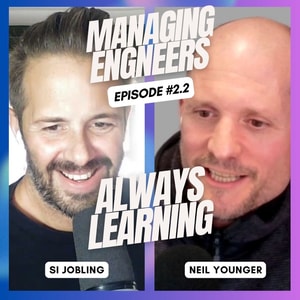
Learning on the job, learning in life, and learning how to learn; two engineering managers trying to keep up without burning out
Transcript
This is the second episode of the Managing Engineers v2, and it's a chance for me and Neil to start reflecting on learning as a concept, as different patterns that we use, and also how much we actually do ourselves with our teams and how we encourage our teams to think more about learning. Strap in as we get into it. Do our personal intros before we go into it. Or should I just do a generic one?
Speaker B:How about for this one, you do a generic one, I'll do a generic one top and tail it for the next one.
Speaker A:What are we calling it, by the way? Because I've played with Managing Engineers. Just because that's what I knew.
Speaker B:I. That is a great question and I was going to ask you about this. What are we calling this podcast? Sorry. Because I'd sort of made the assumption that we could work that out, but also that I thought maybe it would. We'd be utilizing your existing podcast I for ease.
Speaker A:I thought that makes sense to go down the route of hey, I've got a podcast that I tried to do that didn't go typical two episode end. So let's try and do a version two and see where it goes.
Speaker B:Perfect. If you've got it all there, I would just add straight to it. Did you say there was two episodes?
Speaker A:Two episodes, yeah.
Speaker B:Okay, so this is the second episode, right? We are hitting the baseline that you set.
Speaker A:Well, we met expectations now.
Speaker B:Yeah, yeah, exactly.
Speaker A:My KPI was to get beyond 2. So next week we're all good.
Speaker B:Okay. We can guarantee that that will happen.
Speaker A:Sorry, there's plenty for us to talk about.
Speaker B:We might even double it.
Speaker A:So, yeah, this is the Managing Engineers podcast then. Version two. Me and Neil, we know of each other, but not very well. That's why we thought it'd be a great way to get to know each other in public. Talking about some common topics that we share across Managing engineers, software, all that good stuff. And this week Neil's got a topic for us. So I thought let's play with into this. Let's take turns maybe. Do you want to give us a bit of background into why you thought of this topic?
Speaker B:Thank you for the opportunity. We'll describe it as that rather than a Neil, you're doing a thing. I definitely like opportunities. And you talked earlier about learning. We're learning what we're doing, right? Maybe that's clear for some people that we're learning together and we're learning about each other. So learning is going to be the focus of today's conversation. I'm learning, so I Think it's something that has been true throughout my career but I'm really curious what it looks like for you. Sigh. How it, how it's changed. Does it differ? Was it look like for your engineers? How does it work? How do we support it? Yeah, I think there's lots we can go into here. Lots we can learn.
Speaker A:Yeah and just go, go full big picture mode. This is one of the reasons when I created the Petals framework learning was a fundamental factor to my weekly reflections. I want to be learning something new every week. I guess going back right to software engineer mode I was like well I'm going to be learning on the job most days. You know it's. It's quite straightforward to do real world learning but to have the opportunity to do some proper training, some actual courses and conferences. That's where we might want to go off on a little bit of a tangent I think just because I know it's not necessarily a big thing as it used to be but it certainly is something that's come up recently in our workplace.
Speaker B:So how do we. Why don't we start there actually just a reflection on maybe our current workplaces and workplaces that we've been in in the past. I'll start sign. So for start from where I am at the moment there is a budget let's say I've said so some different. I'll pull out some differences as we go. I think there's a company wide budget. In previous companies we've had like department or individual budgets. I particularly prefer individual budgets. It's easier to distribute but I think it allows engineers to understand what they can play with. Sets an expectation. Use it or lose it I guess so Currently we have a. Currently at the current place of work we have a global budget that gets applied to everyone. It gets signed off. We are allowed to sort of play and stretch and flex that and maybe a topic to expand on as well. We also have dedicated learning time which and work and can also not work. I've seen it work really well and not work so well and really interesting. It'd be interesting to play with ideas around that space where we have a dedicated half a day a week around learning. So I guess describe as non delivery work. I see learning as work so I wouldn't want to describe it as not working but not delivery work.
Speaker A:Let's say absolutely very similar to what we've got on then because I think like most large organizations you tend to go let's allocate a part of the budget towards personal development, training and learning, we work out how much we need as it goes, basically. And I think through my time it has kind of evolved from, well, we, we allow a certain amount per person. It could be quite a lot as well. So you get the opportunity to go to a conference or an actual course. And I've seen the other end where it's like minimal, you know, it's like 50 quid per head for the year, which is not going to get you much. But I think without kind of saying which one works best, I think for me personally, I like the idea of having a token gesture to learn from personally and then going back to the organization going, look, I can see the value in someone doing this, not necessarily myself now as a manager or a leader, but I can sort of go, well, you know, I can see my department aren't really needing much at the moment. They've got hands on learning going on, they've got a lot of other opportunities. But this one individual could benefit from some training and that will cost a bit more. So in interest of fairness, we don't talk about how much, but we can see the capabilities that person will get from having this dedicated allowance. And to your point, again, we do try to encourage the 10% time model. So half a day, a week or a full day every fortnight, that is your personal development time. You do not need to do proper delivery. If you want to do something towards our general goals, absolutely on board with that. If it means you're going to do some learning for half a day on LinkedIn learning or whatever, crack on, you know, you got a lot of full support. And I think that's the bit I'm struggling to get the balance right with at the moment because there's so many deliveries. Engineers go, I've not got time for this. Right, well, we've given you time. How do we make that work?
Speaker B:I think that's a consistent pattern that I have seen. At one time I found it surprising, but I think now I have a better realization why it may not always hold true. And that is you can have with the best will in the world a leadership group stand in front of everyone and say, you all got time, folks, off you go. And then, and then the said leadership group will be quite surprised when people make different choices because their context is very different. Like what might be happening day to day, week to week, the investment that they might have in delivering something and really get enjoyment from that as well. So I think it is good to set an expectation that learning is important and model that from within leadership, but also understand where. Where it can not break down, but where it may not work and what you might need to do differently. I've recently just had a. A month worth of internal conferences that worked out to three or four days, not an entire month. That would have been both amazing and quite exhausting. Delivery point of view, but yeah, and exhausting. But over a month and in the past we've had it over a week because of things. We want to experiment a bit differently. So I think that's another way of doing something a little bit differently. Instead of saying you have half a day, put together an event where people can come. It's a, you're all there, no one's delivering unless you're doing it by yourself somewhere. And that would be a bit odd. And everyone's taking part in that. That collective learning, I think can really also cement the word where a leader says it's okay to learn and actually then going to make, you know, putting something on for people where it really backs that up.
Speaker A:And that's something that I've always seen. Again, a similar model, not necessarily a conference, but having a few days of hackathons every year or every certain time frame, that's a really nice way to make sure that everyone's trying to learn something different that they're not used to do a little bit of network in and building a thing that might make it to production at some point, but it's okay to not. And that's my critical thing with hackathon. You don't have to build something for production, but if you can explore how it might work, that's the fun, that's the joy, and that's from the top. Everyone's fully invested in that because there could be financial gain out of it eventually. But they also see the value in sentiment. Of course, the organization of like, oh, we do this every year. I can't wait to it every year. I look forward to it. It's brilliant. It's good fun.
Speaker B:Yeah. What are your thoughts around sort of internal? And I mean that by learning on the job, I guess things that you might be able to experience internally versus external or like. And for that I might mean external workshops, conferences, maybe getting in a course or a speaker. Is there any difference between the two? Is there any more value in one or the other? Both the same?
Speaker A:I think there's different value depending on the context, if I'm honest. Because I mean, let's go back to when we actually met in person earlier this year. That was a really nice workshop. To do in person because it's quite abstract, it wasn't necessarily specific. But I did have to prepare you a little bit with like how our organization is laid up and how the teams are organized. But that's what you need to know. And I think that actually shifted the dynamic in the room as well. The fact that someone from outside the organization was coming in to facilitate, to get people talking, to do some knowledge sharing stuff. I love the fact that it actually sparked imagination and different energy in the room. Cool. You know, because I think if you've got internal training it kind of feels a bit more like box ticking almost. Sometimes it's like, well we can't afford this anyone training so we're just going to provide another senior or lead to provide that knowledge, which I'm not against. And I think they have extra domain knowledge, they have understanding of how the organization runs, the technical implications that might be facing as well. So again we are trying to get a better balance of lightning talks or a little bit of a dev huddle like every month or something. Just to go let's show you a cool thing we've been building recently. Let's, let's look at the.
Speaker B:What's a.
Speaker A:Do you say dead huddle Dev?
Speaker B:Not dead dev huddle. I thought that was. We were going down a. Oh, we're not going dark.
Speaker A:No, no, no. This is definitely. But again, I mean some people are going like counter lightning lunchtime mode. They don't like no, no, no, lunchtime is lunchtime. Protect it. But I'm also like, well bring some sandwich. You know, brown bags are a thing because it's a time to get away from your screen and actually listen to someone and have a chat because you're not going to be working all the way through that half an hour but you are going to be playing around with a few things.
Speaker B:It's really, really true. I like the, I like the thinking around context and as a former tester I would often say, well it depends two answers to a question because it largely does classic tester response. And it does depend. Right. And my view, as long as people are learning, I think that is the outcome we're looking for and they're enjoying the learning rather than it feeling like a forced exercise, which it certainly can be at some point. And I'm particularly mindful that providing one scope, it's like, let's just say as a company it's all internal which will work. We put effort and time into it, but it won't always work and it won't always work for every individual. And I think I like the idea of making sure that we have a mix. And I think that's. That is. Is definitely where I sort of lean towards nowadays is making sure that there is that internal stuff. We're doing internal conferences where we're learning in teams. But we also appreciate that going out to a conference is learning in itself. Not just from the material, but the socializing, the interactions, meeting new people. Like all aspects of learning that doesn't just come from a classroom exercise.
Speaker A:I completely agree. And I think there's something you said there about everyone's different ways of learning. I wouldn't want to dictate how someone learns. I know some people are better visually or through reading or audibly or hands on. You cannot satisfy everyone with one mode. You need to provide more than you know. If you get into metacognition, with which my wife always tries to talk to me about. From a teaching perspective, the theory of learning is really complex, but you have to think about the personality types, the environments, the kind of course content you're doing. I'm very mindful that people disengage after a certain time frame and you need to make sure it's interactive at some point because there's only so much you can present. But that, that's the balance for me. Just trying to go, well, what options are available to everyone? Which is your preference? And if we can get the majority to be happy, then we're good. We're not going to satisfy everyone. I know I will leave a room with 20 people and two people will moan about it being a waste of time, but that's fine. 90% of them are happy though, so I'm all right with that.
Speaker B:It's a really good point as well because sometimes the thing that you're learning you may already know or think you know. But I'm a firm believer that ideas and learnings are ideas of others effectively. In some regards, ideas spark other ideas and they're not always connected. But it's that spark that I think is really beautiful when it comes to learning. Because you might be like. And there are quite a few times where I've gone to a conference and you pick that slot because you're, you know, you're going to be tired. You are tired and I need something that I think I already know, right? And you sit there and the person absolutely blows your mind with something you hadn't thought of, of a connection you've made. And that to me is just the, the power of learning. I Think I agree.
Speaker A:And I went to a conference this year. So back onto the original point. I managed to get tickets to lead Dev early this year, which I've always seen as like, you know, it's the. It's the top. It's the best event possible for people like us. But what I walked away from it was I'm not learning anything groundbreaking here, but so many little things and how things could be better. That's my takeaway from this because, yeah, thankfully we're covering a lot of these bases anyway, which was also a realization, oh, good, we're not far behind most big organizations, but it doesn't mean you're doing it well. So, like, oh, I never thought of it that way. Ah, never thought about that. Challenge. Challenge or. Oh, that's an interesting way. Can I speak to you about that next time I see you? And it may be connect with a few people on LinkedIn as well. Love your talk about neurodiversity in the workplace. Can I catch up with you and have a chat with coffee or something? Just to really understand some of the challenges you faced in that process?
Speaker B:Yeah, that's. That's really important and that's good to hear. I. It's good to hear that you're on the right track. Sorry. I think. I think that learning can help us.
Speaker A:I wouldn't say I'm on the right track. I think I have a reminder that I need to keep learning, otherwise I'll feel a bit complacent. So it's like, what am I going to learn this week? What am I going to learn this month? And then at the end going, what did I learn this week or month? Because sometimes you don't realize.
Speaker B:A few years back, I went to huge DevOps conference in London and there was a talk, I think, from Adidas, pretty sure Adidas. And they talked about their, like, DevOps transformation. It was phenomenal and they did it in a year. And I was like, I'm going to learn so much from this. What I actually learned was they hired a thousand people and cracked it on. Oh, okay. Right. Us normal folk who can't do that, we can take the learnings from what you've done, but also don't beat myself up that I can't get it done in the time frame that you did it. There's some, I think, context to those. Those stories and those learning things.
Speaker A:You ever find that you have higher expectations than what you're going to get sometimes when you go to these sessions? Or is it the opposite? Oh, good.
Speaker B:Question. Sometimes I know the speaker and so for instance, I'm going to Cambridge next and on Wednesday the keynote is Simon Wardley. I've watched a lot of his stuff. I love Wardley mapping. I'm pretty confident that my expect he's going to meet and exceed my expectations from his keynote. So. So I think there are certainly some people who I'm aware of, seen their work, I know it's going to be awesome. And sometimes I. But I also love those sessions where I just come way surprised either way, whether it's like, oh, that didn't work out as well, why was that? Or it worked out great. And it's always something to take from it, I think. And I guess that's why conferences in particular can be useful things because you set aside an entire day, you're not just got an hour of learning for the day. Your brain is in the learning space. It's ready to accept new ideas and they can just pop out at any moment. And I wonder if I'd watched one of those talk back. Let's just say I picked one of the good talks and watched it back for an hour. Would I have got the same from being there on the day, talking to people afterwards, letting my brain mull it over? I'm not sure I would have done.
Speaker A:The good thing about going to conferences, you've got nothing else to do. Because I think when you're at home and you are trying to fit it around your typical schedule, there'll be other reasons why you can't do it. And I'm guilty of this. Maybe it's my role and my type of work I do, but if I, unless I instinctively put in a placeholder in my calendar, I am not going to do it. But when you're at a conference, you cannot get distracted. It's impossible. The only distractions you'll get are the good ones where people go, fancy a coffee? I'm like, I was going to go to that talk, but yeah, I'll prefer you actually, let's do that. And it's those little moments where you go, ah, I didn't realize that's what you're doing. That's really cool. I've learned more from you than I planned from that schedule that I signed up to three weeks ago. Because I've realized in the day some of the content is not to the level I was expecting. So I'm going to make the most of the networking instead.
Speaker B:Really? That's really neat. And it, it makes it really visible as well, right? Everyone's Learning. You're in the mode. And I remember when we were attempting to introduce learning or the opportunities to learning in. In a previous company I worked at, it was quite difficult because it wasn't seen. It wasn't seen to be modeled. So I chose to find the most public chair I could and sit there with a book and just. And just wait for people. And I'd read it, and people would be like, hey, Neil, what are you doing? I'm reading a book. We're allowed to learn. And they're like, oh. And it's just. Sometimes it's just about now, I wouldn't have chosen to read a book in public. It's not how I would like to learn. But it was the most visible thing that I could think of that. That tried to say, like, look, I'm. I'm okay with this. People have said what? That they're okay with this. I'm just going to model the behavior that I think we can do. And then some people joined. Some people joined on the ciphers, and we read together, and some people went back to their teams. And I think the more visible sometimes it comes, the more acceptable it is and the more. More of a culture you can build around.
Speaker A:Do this in the office where you, like, a breakout area or something, or was it somewhere else?
Speaker B:It was, yeah, much, I think, much harder to do remotely unless you start making use of, like, you know, hey, I'm huddling everybody on slack.
Speaker A:I want to sit on slack, watch a video call while I'm reading. This is gonna be really awkward work.
Speaker B:Yeah. So it was in an office in a very visible space where people would walk past. Yeah, it was an uncomfortable few weeks.
Speaker A:So did you all read different books or the same book? How. What was the model there?
Speaker B:So initially it was just me using the book as a really. As a. A visual observation that learning was okay. But I think it turned into a book club. At one point there was like, oh, what are you reading? Oh, I'm reading this new. Can I join? Of course. I'm on chapter two. And then since then, there have been other book clubs, haven't been a part of all of them. And that's okay. Reading isn't always my thing at the moment. It is sometimes, but not always. And it was just. I think it was more around, how can I make learning okay? And as visible as possible. And that was what I chose.
Speaker A:That's cool. We've got an energy manager in the office now, and he does that intentionally every lunchtime not to call it out. But it's like no, it's my lunch break. I'm going to read and make it public as well. I'm going to sit in the breakout area to do it. So hopefully others get the idea that it's okay to take a break and read a book. It doesn't have to be work related either. It's just whatever. Just take that time out and do a little bit of self development. And I want to ask you what your thoughts on audiobooks.
Speaker B:Oh so as a. So back to my childhood I would read so much. We go to the library every Friday and I would pick up all the books. All my family would and we would spend hours. I would get lost in books. Loved them less so now as I've got a bit older I feel like time is. Is sometimes my enemy. I do like sitting down and reading when I can but it's not very often and I'm not a you know, 15, 20, 30 person book physical book in my one or two if I'm lucky a year. But I do use a lot of audiobooks. I've been experimenting with Blinkist which has its positives and negatives. I think the positives for me Blinkist are I can listen to it on a walk so I get exercise. Negatives are you get a very shallow snapshot. However, what it has meant is I can go really broad with what I might want to learn and actually then go and pick up the book from Blinkist or go and expat go into the topic in much more detail. So I find it's like a useful broad scope to target my learning. If I just used it as a means to read I don't think it'd work too well. But yeah, audiobooks. I've listened to quite a few audiobooks now. I like being able to move and walk and get learning at the same time. Yeah, it feels like good value for money.
Speaker A:We try to be more efficient with our time as typical.
Speaker B:Yeah, exactly.
Speaker A:No, I'm, I'm like you. I, I love the idea of Blinkist when I was told about it went oh I can start to understand some of these books I keep hearing about. So it's just an opportunity to do it while I was walking the dog without having to think I need to sit down for half an hour to understand this at least. It's like no 25 minutes. I've got a 45 minute walk. I can maybe get two books in at a push. This is all good but to your point as well, if it's very good I'LL be like great, I'm going to go and buy it. I want to read it properly now or do some thorough research because like you say the nuances are lost. It's Blinkist interpretation of a book. It's not necessarily good. I found that fiction's awful then how anyone can do that but the non fiction absolutely great. So I was going down a bit of a rabbit hole like thought leadership. I was going to the rabbit hole of mental health and neurodiversity. So like just going down those sort of pathways with blinkers to see what and suggest I was like oh never heard of them. Let's listen to that. And that's what I liked about it is the discoverability and the convenience of just going. It's all available.
Speaker B:I think I would agree. So if I was to let's just pick a subject like neurodiversity I could go and read quite a lot of heavy books and that I reckon that would take me a good number of months to digest. On the rest maybe I would go off down a track that wasn't going to be useful. So picking one or two items on Blinkist it's short form. I can get some information in my brain and go right I understand it a little bit more and it just helps my search. I, I feel like it's a. It's a good use of yeah broad searching to. To see when you want to go really deep but.
Speaker A:And then on the flip side I've used it for a year. I ran out of content so I've canceled my subscription because I was just like oh really not getting value out of it now. I mean I won't go back but I do get their Constant reminders good. 60 off. 70 off went. Wow. How cheap are you to run?
Speaker B:They do if you say no a few times it, it turns out like can you just have it for free please? We want you back.
Speaker A:I think I've got it on one of those promos like 80 off went. Okay that's sure because out.
Speaker B:But yeah it's. I think it has its value. Right. But it's, it's as with any tool you have to understand where it, where the value comes for you.
Speaker A:Exactly. But on the, on the concept of reading I do like you sit down with a book and do it properly. If I'm going to do it I prefer that time with no distractions and actually feeling the paper and turning the pages and dog earring them and all that sort of stuff. That's a bit I from digital but Books after, during lockdown and on the short few years after, I pretty much sat down every morning for an hour and a half with my Kindle smashing through books like every morning. They're all non fiction, sorry fiction in the end. But I enjoyed the downtime, I enjoyed the quiet time. And then we got a dog. I was like, oh, I can't have this anymore, I have to take the dog for a walk.
Speaker B:Life does have a habit of saying, remember all this time that you used to have, well have, have, have a family and have have and even commuting.
Speaker A:Right. Because I used train from like the Midlands to London every day and night. So I'd have about an hour on the train. That'd be a great time to just read or watch something or binge something. And I tried not to binge junk too much because I was like, this is valuable focus time, I don't want to waste it.
Speaker B:What we haven't touched on and I've only just thought about it, it's because you mentioned about traveling to work and I don't do that anymore. I work remotely. But the one thing we've learning that I think is a companion is reflection. And sometimes you need to let that learning and ideas sit. And I found so I would cycle every day to work, rain or shine. We had no option for a car. So it was half an hour there, half an hour back, an hour a day. It was a great start and end to your, to your workday. But I found the motion of cycling quite rhythmic and I also found it a great reflection time. And sometimes it would be a reflection on the day, but often it might be a reflection around some of the learning and my brain would just pop in an idea like hey, remember that thing that you saw last week? Oh yeah. And I find that reflection time with learning you don't give yourself an opportunity to just let it sit for a bit.
Speaker A:Yeah.
Speaker B:And sometimes it can just be lost in the consumption of more and more.
Speaker A:Knowledge or depending on your setup. Like if I go to a training session in the on London office for example, that's like normally a day long session that'll be broken up nicely but you pretty much like go bang into the mode till 4 o', clock, go home quick, get the train. I'm not going to process that straight away, but eventually maybe when I've sat down at home and the wife asked me how's your day? I went, I did another training course today, do you want to hear about it? She's like, no, but go on then. And I was like, but I know, because she's a trainer herself, I'm like, you might learn a few things yourself in the process. Meta. But it would become later, like days away. The one I'll go, ah, that's why we did that thing. That's why I can use it now. I can try it. I can use this model or this method of facilitation or conversation or whatever it was we went through.
Speaker B:Yeah. And that's why I, I think I like the, It's a particularly like the walking and learning. And now because it's not always walking and learning, it sometimes starts off with like, I'm going to learn a thing. And it immediate my brain is like, no, you're not. You're not listening to this, to this podcast or something else. You're now reflecting on that thing that you're like, oh, am I? Okay, well, let's do this then. And it's that time where you can walk and just be like, like actually think things through. And you said a bit of downtime to, to work through. Because it can be right. We, we have opportunities to learn and take on new information constantly in our roles.
Speaker A:Absolutely. And actually, back on your point around cycling, I'm finding my most cathartic but inspirational times when I'm swimming in the morning now, like, I will go into the gym, I'll do a bit of a running, I'm going to show off with my fitness regime because I'm not that good at all. But I'll do like a run and listen to something while I'm doing it, then jump in the pool for half an hour. But like you say, that rhythmic, calming environment, all the ideas come flooding in and I'm like, I need to write this down. This is great. Or how do I go and do that? I've got, I've got wet hands, I can't even touch a phone, let alone use it, you know, But I'm like, I need a better model to kind of just go, got an idea. Get it down quick and I'll look into it later. And I have found chat GPT voice mode quite useful for this, especially like if I'm driving, for example, I can press the voice command button on the steering wheel. She pops up and I just say, got an idea. Take note. We'll come back to it when I get home and I can have a conversation with them about it as well. Because I say, does that make sense? Give me some ideas around this. What other people done about this before. Okay, cool. I want to dig into that when I get back and sat down on my sofa this evening with a drink of some sort.
Speaker B:Nice. And for those of our listeners who are listening purely on audio. Sigh has been mimicking both jogging and swimming during the last story.
Speaker A:Go get visual with your talking of it.
Speaker B:Yeah yeah I mean it's, it's good because I, I, I won't go down this rabbit hole I used to swim for. She we're about to go down the rabbit hole. I used to swim my county at one point where I just used so much swimming. It's, it's one of my happy places. Being in water is just very relaxing for me and it always has been.
Speaker A:So so go on then. What was your record that you did? Because I've managed to.
Speaker B:No, not a lot I didn't I was young. I was so I could do I practice all the different strokes. Butterfly was always I found particularly effective but hard work like especially race scenario butterfly is quite, it's a very different action but yeah just lots of it was just competition swimming swimming with weights, swimming with floats constant practicing lengths. We didn't really do much. I think longest I've swam was a was a couple of miles just but yeah I love it. I think it's, I think it's really important. This is one of those things that I'm really proud. Not proud, wrong word. I'm really pleased that my parents were like this is an important thing for you to learn. Going back to learning like we, they're like we think that swimming and being a good swimmer is an important skill for a child and an adult to have and I like eternally thankful for.
Speaker A:And it actually I mean we are getting a bit off on track here but the ability to learn to swim I think it was, it was really big back in our generation like you it was just an expectation. Every school kid went to a pool to learn the foundations of swimming. So if you didn't then you'd probably be left out but it'll be the minority. But now I mean I'll go swimming with the family and my father in law can't get in a pool. He was just like nope, don't want to go in there. I'm like wow, it blows my mind sometimes. It was a fundamental part of our learning process as kids. These were certain things that everyone knows.
Speaker B:It was and it also wasn't a choice as such as such like there was probably some choice. Right. But it was a decision that was probably made by our school or our parents that this is an important learning thing. And I wonder if that also comes true in work. And in terms of this, we think is an important thing for. It's interesting actually for us or you.
Speaker A:To learn because I think when you're in the education system, you just follow the rules, right? You're like, can't, can't break the rules, got to go to all my lessons, got to do all the work. But in a workplace you're just like, I've got a thing to do, that's all I need to worry about. If you mandated some sort of learning of some sort, then people look for the opportunities and go, oh, how what I'm going to do in my half hour this week or my half day this week or whatever it is they're allowed to use and even just go, well, I'm going to say the expectation is your line manager. I want you to learn one thing in the next two weeks and tell me what it was when we get catch up next time. I don't care what it is, how, how complex it is. I just want to hear how it went and what you learned from that experience.
Speaker B:Nice. It's nice to make a commitment with someone as well and, and say, and I will do that too. I will totally.
Speaker A:And I'm like, do you want to hear what I learned? Because I've learned lots of rubbish lately, but I can tell you what they are if you want.
Speaker B:There's quite a model that I like using. Model's a fancy word for a quadrant with, with. With engineers or anyone actually myself when I'm thinking about learning and that is to sort of to start small but build out. So what might I need as an individual? And that could be quite personal, what my, my team need. So that might be around, I guess, soft skills, technical skills. But what, what am I looking at for my team? Maybe there's a piece of project work and it's been written in a language that we've never done before. Do I need to focus some learning around that? So we've got personal, we've got team go a bit wider. What is maybe our department doing like this quarter, next quarter? Are other teams doing something that I can help them learn because I have the skills and they don't. So that cross pollination and then one step further, which is like, maybe what does our business need? Like, do I need to. Like, maybe we're going all in. I mean it's a common thing, right? Someone has said we're going all in. AI.
Speaker A:Right.
Speaker B:And I have no idea what AI is. Do I need as a, as an engineer, as an engineering manager to know more about that, to make sure I at least understand the conversations that will be coming up this year, maybe next year. So I like thinking about it that way because it can sometimes challenge people to think differently when it comes to learning rather than just thinking about what maybe they need or what their project.
Speaker A:Yeah, it might help people that don't really know what to focus on next. I've got a few people that I manage to go, I just don't know what to learn next. I've got the foundations for everything I need to do. What else do I need to learn? I'm like, well, I could start having that conversation going, well, what do you know about X? What do you know about Y? What do you know about cloud? What do you know about AI? And when you go, oh, actually I quite like that I went, got you. Right, let's go down into that rabbit hole and see what's possible with you. Because everyone's got different angles and you said the buzzword AI. Everyone's trying to get their head around it at the moment to understand what it actually does, what it's capable of, the pros, the cons and all that sort of stuff. We've got an org wide initiative that everyone should be thinking about using AI at in their job. Doesn't mean it's replacing you, but it's going to helpfully make you more efficient so you're not wasting time, which is the key for us. But the amount of times people going, I don't know where to start. I'm like, we know. So if you're an engineer, go into more dev based stuff. I'm not going to say vibe coding, but go into more engineering stuff. If you're a manager, is there anything you want to learn around how you organize your stuff or how you annotate or use transcriptions or whatever, or even automate some processes. But it's just knowing the context of the individual and then sort of going, what level do you need to go to? And what foundations have you got? Because I don't think everyone's got enough foundations in the current ecosystem that we need at the moment.
Speaker B:It'd be worth highlighting because I think we're really, we purposely talking about how much we value and we think learning is important. But I don't think either of us are saying, certainly I'm not that it's a constant march because that's tiring and it can get tiring for people. And actually it is okay if someone doesn't want to learn anything or they're tired from learning. And it's also okay to reflect and look at the scenery. Right. Especially if you've gone on a big journey. Like, it's okay to be like, that was hard. Like, I've learned loads of new stuff and I think I'd like to cement that learning now. Like to practice, to cement it, to get better at it, or just not actively go and seek new learning opportunities. I think that, that, like, with anything, it can get tiring. And it's, it's good to be able to step back, reflect, pause for a little bit, but maybe not for a year and just. And, and yeah, I think that's, that's really important that, that, that time for you to. Because it can be tiring.
Speaker A:Oh, totally. I think, like, when you were saying earlier you did like these, these training sessions, like for 19 people or something, that's going to drain you, man. There's no way you're going to be able to do that again today because it was yesterday, but. Or maybe not as well as you did yesterday, at least, because it is energy that we're using for our brain, for our body, everything that we do. Especially if you're in person from a remote organization. Wow, you got a lot of extra usage in your body just to kind of go right, you there, you there, rolling, going. I'm going to press some buttons on the screen. But my point is, I think, yeah, taking that respite. Calm down. There's a reason why schools, colleges, all have breaks, because there's no way students can continuously learn for a year, nonstop. I would not expect my people that I look after to do the same. I'll be like, look, what is your goal for this quarter? When you're taking a break? What's your goal for the year? When are you taking your break? When are you going to reflect to make sure it's still relevant? Because that's the other thing we're thinking, like, what am I learning this week, this day, this month, this quarter? Think big. Bring it down to what's manageable. Check, it's still relevant. Check, it's still relevant. Check, it's still relevant. Are you on Pete path? Because it's okay to deviate. It's your learning here, not mine. But it's just getting. I like your analogy of start small, make it bigger, but think about where you're going. Because that's the key. Really?
Speaker B:Yeah. And like, with any journey, it's okay to be like, well, that was the wrong choice. Yeah, like that. That path was not the one I should have gone down today. That was a deep and dark forest and I should have taken the beach. Yeah, definitely important to like, it's okay to. To stop and reflect on some learning and. And assess the value.
Speaker A:That's a good one then actually. So.
Speaker B:And be like, not.
Speaker A:When you're line managing people and you set some sort of goals or objectives around their development, how often do they check that they're still relevant?
Speaker B:Well, that's a good question. I would say not as often now that you mentioned it and. And honestly not as often as I would like to and probably should do. Fortunately, I work with some amazing people who will be checking that in for themselves.
Speaker A:How do you feel like you're doing that on that journey?
Speaker B:How do I. Yeah.
Speaker A:When you're. How are you checking your development areas regularly as well?
Speaker B:I. Not as much. And there's definitely something that I would like to focus more on. I think I set from history quite a high bar for myself in terms of learning, looking back throughout my career and what I needed to do. And I'm not too sure I'm at that bar at the moment. I don't think I'm bad in any stretch of the imagination. It may just actually been that this is quite a nice reflection period and I can be okay with that because if looking back, right, everything say an opportunity to learn. And I'm off to a conference next week and I run workshops and I'm. So maybe that's enough and maybe people will say, no, Neil, you're doing fine. But sometimes I feel like there's so much I could learn and it's a good reflection on me whether actually just to take stock and look back. But it's the reason I'm doing this podcast with you. Sorry, I was like, I want to learn something new. I haven't done podcasting before. I haven't done editing. I haven't done thinking about sound or even pronouncing sounds. And yeah, I just thinking about learning. And this is why I wanted to focus not just on work learning. This feels like it is work in some way. We're talking about what we know, but this is fun for me and we're learning. I need to. I. Sometimes it's good to remind yourself that learning is also fun and not. Not always.
Speaker A:Practice should be, but not always. I think I've had some training recently, some mandatory training about data protection. That ain't fun, it's just required. Yeah, we.
Speaker B:We have some around risk and fire and health and safety.
Speaker A:And I think I've got a tax training session next, next Thursday. That one I'm really looking forward to. I joke in a way, I am actually looking forward to it. It sounds really dull. And when they sold us it, I went, really? But when they told you, the detail went, oh, that could be quite good. It's about R D sort of benefits and stuff like that, but.
Speaker B:Oh, nice.
Speaker A:The other thing is I get to go to London for the day, so I get to explore other things and meet other people again, which is one of my happy places.
Speaker B:I get to. You get to learn. Yeah. I think that's the other thing is sometimes creating a time and space for learning that environment sometimes is. Is. Is just, if not more important than the learning itself.
Speaker A:Totally.
Speaker B:The ability to create that time and space.
Speaker A:Yeah. And I. I regularly block out my Friday afternoon to do personal development learning. There might be some admin stuff to do. It will get done. It will probably prioritize normally, but at the same time I am trying to find a LinkedIn course. I can chip away at 25 minutes, get a Pomodoro in every week. That will do something better than nothing.
Speaker B:Nice. I need to take some lessons from you. I. I'm certainly finding my schedule quite sporadic at the moment, but this is. Well, I've learned something today.
Speaker A:There you go.
Speaker B:So I'm going to count this towards my learning quotation.
Speaker A:I've learned stuff. I've learned a lot about you and your swimming. I'm impressed. Learn how to do butterstroke butterfly stroke with you?
Speaker B:I can't do it, but I think it would be an embarrassing mess. I could still do it, but it's. It's tiring. Right. It's a tiring thing and I think I'm. My body. My body would be more happier with just front crawl or breaststroke.
Speaker A:Breaststroke for me. It's a nice, safe one. I can get more laps in that way.
Speaker B:Yeah. You can see where you're going as well.
Speaker A:There's less people that do backstroke. Blow my mind. I'm like, do you know where you're going?
Speaker B:No. You just. The trick for this is to look at the ceiling and make sure that you know a point in the ceiling where you're going to hit the wall and you get ready to turn.
Speaker A:I might try that tomorrow. Yeah, I learned something.
Speaker B:There we are.
Speaker A:I don't know if we covered all bases now with learning, then I. I think so.
Speaker B:I. I was just going to ask you, are there any examples that you wouldn't repeat or haven't worked out as well that you would have liked from a. From a learning point of view, either personally or something you've tried out with your team or you've seen a company do, that maybe just was the wrong time, didn't mean the wrong thing, but maybe just the wrong time for it.
Speaker A:I remember one. Not off the top of my head, no. What about you?
Speaker B:I've been fortunate that we've always had the things I would change, like mandating. This is the time where everyone does learning. Sounds like a great idea, but in practice, it's very difficult. I mean, if you have one team and that's your company, then you know that's okay. But as soon as you have two teams, three teams, four teams, context is so different. And it actually becomes. As soon as you make it difficult for someone to make a choice and they're like, well, actually, I need to choose delivery this week. I think, I think you haven't made. You know, it makes it difficult for them, and then they may not want to make that choice again in the future, like, commit towards learning. So I've certainly come with good intentions and be like, hey, folks, we're all doing this thing at this time, and it just doesn't work as you scale out. I think that would be my. Sort of. One of my key ones is to make sure that learning is valued and modeled by a company in leadership and that people have the time and the space and also the finance and the capital. Because some learning is costly, but also.
Speaker A:The agency to make that decision go, well, oh, you know, yeah, I haven't got time for this, but how come my boss has went, you can do it. You can say no if it's. If you think there's better value in you learning this week, I, I want to encourage every time, but you're willing to challenge it at least, and going, why? Why am I doing that instead of my learning? I'm like, good question, actually.
Speaker B:Yeah. And it's just. And I think you're right if, if people feel comfortable making and flexing that choice, there might be a time where. Let's just, just. They don't do learning for a week and then they do more and they'll feel comfortable flexing what's valuable for them.
Speaker A:But as we said earlier, everyone's got their own time to learn, their own way to learn. Don't say, oh, you only learn on Friday afternoon. Oh, my God, who learns anything on Friday afternoon? You need to find a better time.
Speaker B:This is true. I mean, it is Friday Afternoon now. Sorry. And we are.
Speaker A:It's lunchtime. It's just about. Okay.
Speaker B:We're getting in over a sandwich and I guess the other one for me I've seen it work and not work. So I'd be careful with this one. And that is like team. Team based when a team is committed to learning because all it takes is one person to not feel comfortable and then they feel excluded and that isn't the environment that you want to create for a team. So I think where I've seen it work well is when a team has agreed and they've committed to it rather than someone suggesting or volunteering a team. This is your time. You're going to learn together. I think when it comes organically from a team and you that from a leadership point of view I think it has much more. People feel much more safer with it because it's also learned agreeing collectively rather than.
Speaker A:So go well we've agreed as a team to do it at this time. Let's try it for a few months or whatever and see if we need to adjust because no, we're not going to get it right first time.
Speaker B:Yeah. The key ones we. Oh I'm making sure that you know you have some sort of budget or finance to support learning because there's only. You can do a lot internally.
Speaker A:I think before we wrap it up then what. What would you. You budget yourself to learn? If it was on personal finance like you mentioned Blinkist earlier, was that your personal budget or was that work thing?
Speaker B:That's my personal one. I have quite a lot of personal budgets that I apply to. To learning. I just put it. I probably put a figure at a thousand pounds a person.
Speaker A:Yeah. Arbitrary number. Quite a good one.
Speaker B:Arbitrary number. Yeah. Scaling. But you have to flex that. Some people won't spend it, some people will spend more. That's okay. I've also liked budgets from a community level. So we used. I used to have a budget for a community of practice when I was looking after them. And so we had the individual learning but then we had the community shaped learning and social learning and being able to fund that to get people speakers in workshops, run conferences that we might go to as a group. I found actually that super super useful and super powerful to have have not only that personal budget but that community budget.
Speaker A:I think as a community leader it gives you the encouragement it better for everyone because you kind of go I know the sort of stuff we should be looking into. I found a really good person or I've been recommended someone that's really good. I don't have to worry about getting sign off on this. I just go and do it.
Speaker B:Why? My most memorable community event was when we had an off site and we could use the budget for that. But part of the budget was to cover a guest workshop presenter who joined us for half of the day, enjoyed us for the whole day in fact. And he was running security workshops and he bought all his toys and gadgets along and started the session with like so let me tell you about the hotel wi fi and let me tell you about all the things that you have all been been messaging around and talking about and like he was scary but also awesome. Like and you don't get that experience internally on very rarely. That's the sort of experience that costs people time and money to bring to a group.
Speaker A:But it's so very rewarding an SME in that domain as well. So I'm imagining this person was from a security background. It did a lot of stuff and with real world security, not just online software. But I love that idea of just going hey, don't join the wi fi. Have you seen what I can do with it?
Speaker B:Yeah. And they came and they. And they took apart our Android app and pointed out all the flaws. Like that type of knowledge is invaluable. Like we all came away learning one. We were now quite scared. But also we had learned so much more around security than I think we would have got from a course, an internal event or something else. Right. And that only came about because we had the community to budget to say we think this is important for our community to learn more about security.
Speaker A:I love that I might take that one away. That's another one I've learned today. Thank you.
Speaker B:Nice.
Speaker A:Should we wrap it up there then fella?
Speaker B:Yeah. How was the. The topic of learning? Did you learn?
Speaker A:I learned loads from you. I'm gonna have to decompress when I've got time. You totally enjoyed that.
Speaker B:But grab Chat gtp, do your talk, talk into it and make some.
Speaker A:I might look at the transcript just to remember but no, definitely not going to be using chat GPT for that.
Speaker B:Awesome.
Speaker A:So what about you?
Speaker B:Yeah, I did. I had a lot of fun today. It's reminded me of some of the things that maybe I've forgotten or need to focus back on and just reminded me of just how important learning is, has always been to me and, and I think it will always continue to be for me in my role. As every context changes and evolves, you need you to change and adapt, reflect on Always learning. Be reliant on your old knowledge. Yeah, Always learning and always changing. Always things I know I learned 10 years ago. Maybe not so relevant.
Speaker A:Probably redundant in some ways.
Speaker B:Yes, very much so. It was lovely talking to you today.
Speaker A:Always, Neil. Love it. Next. Same time, next time then.
Speaker B:Well, we will hit the. The magic.
Speaker A:Magic.
Speaker B:So three. So we will.
Speaker A:Three. Three is the magic number.
Speaker B:You'll be bringing the topic, which.
Speaker A:Yeah.
Speaker B:Will surprise me when we.
Speaker A:When you tell yourself.
Speaker B:Excellent. You need to give me a heads up if you drop AI into this.
Speaker A:It might come up, but it won't be the main leading topic, that's for sure.
Speaker B:Okay, nice, because I'll need to go and do some learning. Sam.
In this episode, Si and Neil dive into learning as engineering managers, how they approach it personally, how teams respond to it, and why it’s weirdly hard to make time for something everyone claims to value.
They chat about learning budgets, 10 percent time, hackathons, internal conferences, external speakers, audiobooks, Blinkist, reflection time, and why inspiration often hits when you’re nowhere near your laptop. They unpack different learning styles, the pressure to deliver, how to support engineers who don’t know what to learn next, and why rest is just as important as active learning.
Links mentioned in the episode
Here are the references we talked through:
-
Wardley Mapping: https://learnwardleymapping.com
-
LeadDev Conference: https://leaddev.com
-
Blinkist: https://www.blinkist.com
-
LinkedIn Learning: https://www.linkedin.com/learning
-
Agile Cambridge: https://agilecambridge.net
-
R&D tax credits: https://www.gov.uk/guidance/corporation-tax-research-and-development-rd-relief
Connect with us
Tell us what you think about the episode or learning yourself:
-
Si on LinkedIn: https://www.linkedin.com/in/sijobling/
-
Neil on LinkedIn: https://www.linkedin.com/in/neil-younger/
Chapters
-
[00:00] Setting up episode two and the learning theme
-
[01:39] Why learning matters to us as engineering managers
-
[03:30] Budgets, 10 percent time and the reality of making space
-
[07:14] Internal learning, conferences and hackathons
-
[09:01] External training, facilitators and different learning styles
-
[13:14] Conferences, insights and the value of being in the room
-
[17:51] Making learning visible and building a culture around it
-
[20:20] Books, audiobooks, Blinkist and how we actually consume content
-
[25:18] Reflection time, walking, swimming and idea generation
-
[33:03] Helping people choose what to learn next (including AI pressure)
-
[34:25] Rest, burnout, and why taking breaks is part of learning
-
[44:05] Community budgets, experts and learning that sticks
-
[47:09] What we both learned this episode and wrapping up
Credits
Produced by Unstyled Studios
Hosted by Si Jobling & Neil Younger
Audio editing by Si Jobling
Made with Descript
Hosted on Pinecast
Check out our podcast host, Pinecast. Start your own podcast for free with no credit card required. If you decide to upgrade, use coupon code r-b0b82e for 40% off for 4 months, and support Managing Engineers.